
Roman Numerals
Roman numerals are a numeral system that originated in ancient Rome and remained the usual way of writing numbers throughout Europe well into the Late Middle Ages.
If you love all things Italian or Roman and want to learn more or find a Roman Numeral converter you’re in the right place!

Credit: Pexels.
Here you can Convert Roman numerals to numbers and convert numbers to Roman numerals.
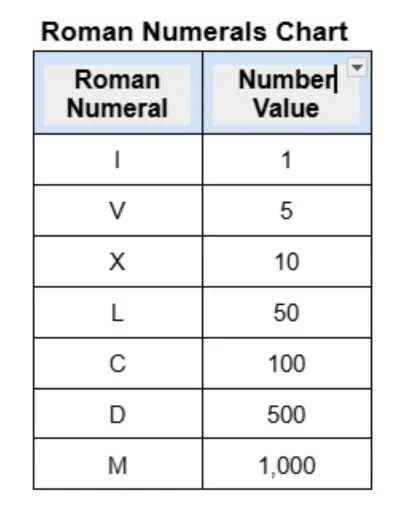
Roman numerals are a number system developed in ancient Rome where letters represent numbers. The modern use of Roman numerals involves the letters I, V, X, L, C, D, and M.
Basic Roman Numerals Chart
If you want to see the main denominations at a glance this is useful.
However if you need a brilliant Roman numeral converter to convert numbers from 1 to 3,999,999 into Roman numerals. Or input a Roman numeral to get its value as a Hindu-Arabic number, which is the everyday modern number system used in English. Try this tool below:
Adding, subtracting Roman Numerals
A number containing two or more decimal digits is built by appending the Roman numeral equivalent for each, from highest to lowest, as in the following examples:
39 = XXX + IX = XXXIX.
246 = CC + XL + VI = CCXLVI.
789 = DCC + LXXX + IX = DCCLXXXIX.
2,421 = MM + CD + XX + I = MMCDXXI.
Any missing place (represented by a zero in the place-value equivalent) is omitted:
160 = C + LX = CLX
207 = CC + VII = CCVII
1,009 = M + IX = MIX
1,066 = M + LX + VI = MLXVI
The largest number that can be represented in this manner is 3,999 (MMMCMXCIX), but this is sufficient for the values for which Roman numerals are commonly used today, such as year numbers.
With the converter above you can add, subtract, multiply and divide Roman numerals from I to MMMCMXCIX and/or numbers from 1 to 3999. Get answers in Roman numerals and regular numbers.
Your answer may contain Roman numerals with an overline. An overline means that the value of the Roman numeral is multiplied by 1,000.
The use of Roman numerals has continued long after the decline of the Roman Empire. From the 14th century on, Roman numerals began to be replaced by the positional Hindu–Arabic numeral system; however, this process was gradual, and the use of Roman numerals has persisted in some contexts, such as on clock faces.
Credit: Furey, Edward "Roman Numeral Converter" at CalculatorSoup, https://www.calculatorsoup.com - Online Calculators