What Is ADHD in Children? Signs Parents Should Know
/ADHD in children is one of the most common brain-based conditions seen in childhood. It can affect focus, activity level, impulse control, emotions, and school life. But here’s the key point. ADHD is not laziness. It is not “bad parenting.” And it is not a child simply choosing to misbehave.
The CDC describes ADHD as a common neurodevelopmental disorder of childhood. Symptoms often begin in childhood and may continue into the teen years and adulthood. The signs can also affect life at home, school, and with friends.
So, what does that look like in real life?
A child may forget homework again and again. They may lose their jacket three times in one month. They may interrupt, wiggle, climb, talk fast, or melt down when a simple task feels too big. Sound familiar?
Of course, every child gets distracted. Every child has wild days. The difference with ADHD in children is the pattern. The signs are ongoing. They show up often. They get in the way of learning, friendships, chores, safety, or family peace.
Parents often say, “I knew something was going on, but I couldn’t name it.” That feeling matters. A parent’s gut is not a diagnosis, but it can be the first signal to look closer.
The good news? ADHD in children can be understood. It can be supported. With the right plan, many kids grow more confident, calmer, and better able to use their strengths.

credit: unsplash.
Common ADHD Symptoms Parents Notice First
ADHD in children often shows up in three main ways: inattention, hyperactivity, and impulsivity. Some children mostly struggle with focus. Some seem driven by a motor. Others have both. The CDC notes three presentations: predominantly inattentive, predominantly hyperactive-impulsive, and combined.
Inattention can look quiet. That surprises many parents.
A child may:
Daydream during simple directions
Forget daily tasks
Make careless mistakes
Lose school items
Avoid work that takes steady focus
Seem not to listen, even when spoken to directly
Hyperactivity is often easier to spot. The child may squirm, fidget, run, climb, tap, hum, or talk more than expected. But not every child with ADHD bounces off the walls. Some feel restless inside. They may look calm, yet say their brain feels “too loud.”
Impulsivity can be the hardest part for families. Why? Because it can feel personal. A child may grab, interrupt, shout answers, touch things, or struggle to wait. They may know the rule but act before the rule reaches their brakes.
That can lead to a painful cycle.
The child gets corrected. Then corrected again. Then punished. Soon, they start to think, “I’m the bad kid.”
That is why early understanding matters. ADHD in children is not an excuse for every behavior. But it is an explanation that helps adults choose better tools.
Attention Issues, Hyperactivity, and Impulsive Behavior
ADHD in children can look different depending on the setting. At home, parents may see battles over shoes, brushing teeth, bedtime, homework, or screen time. At school, teachers may see unfinished work, blurting out, messy desks, or trouble sitting during lessons.
This is one reason diagnosis should not be based on one quick moment. A child can behave well in a doctor’s office and still struggle all week. A child can focus on video games and still have ADHD. Why? Because ADHD does not mean a child can never focus. It often means the child has trouble managing focus, especially when a task is boring, long, hard, or not immediately rewarding.
The CDC says ADHD symptoms can continue, be severe, and cause difficulty at school, at home, or with friends.
Here’s a simple parent check.
Ask yourself:
Does this happen often?
Has it lasted for months?
Does it affect school, friendships, safety, or family life?
Do other adults notice it too?
Does my child seem upset by their own behavior?
That last question matters. Many children with ADHD do not enjoy the chaos. They may feel embarrassed after interrupting. They may cry after losing control. They may want to do better but lack the skill in that moment.
That is where support changes everything. Instead of asking, “Why won’t you behave?” try asking, “What skill is missing here?”
That small shift can lower shame. It can also help parents respond with structure, not anger.
ADHD Diagnosis in Kids and When to Seek Help
A diagnosis of ADHD in children should come from a qualified health care professional. This may be a pediatrician, child psychologist, psychiatrist, or another trained clinician. Parents should not self-diagnose based on a checklist alone.
The American Academy of Pediatrics recommends evaluating children and teens ages 4 to 18 for ADHD when they have academic or behavioral problems with signs of inattention, hyperactivity, or impulsivity. The process should include reports from parents or guardians, school staff, and other adults who know the child well.
That matters because ADHD must be seen across settings. A child who only struggles in one classroom may need a classroom fix. A child who only acts out during a major family change may need emotional support. A child who is tired every day may need sleep checked.
Also, ADHD can overlap with other concerns. NIMH notes that ADHD may occur with learning disorders, sleep problems, anxiety, depression, or conduct problems. These can make diagnosis and ADHD treatment more complex.
Parents should seek help when behavior causes real strain. Not mild annoyance. Real strain.
For example:
Your child is falling behind in school.
Homework leads to daily tears.
Friendships keep breaking down.
Your child has frequent emotional blowups.
Safety is a concern.
Teachers keep raising the same issues.
Your child says they feel “stupid,” “bad,” or “different.”
A good evaluation should feel careful. It should include history, symptom rating scales, school input, and screening for other causes. It should not be a rushed label.
Parenting Strategies, School Support, and Treatment Options
ADHD in children often improves when parents, teachers, and health care providers work as a team. Treatment is not one-size-fits-all. The CDC says ADHD can often be managed with the right treatment, and families should work closely with the people involved in the child’s life, including teachers and other caregivers.
For younger children, behavior therapy and parent training are often key first steps. The CDC’s clinical care guidance reflects AAP recommendations, including behavior therapy as an important treatment approach, especially for preschool-aged children.
At home, simple systems often work better than long talks.
Try this:
Give one direction at a time.
Use visual checklists.
Keep routines steady.
Praise effort quickly.
Break homework into short chunks.
Use timers.
Give movement breaks.
Prepare for transitions before they happen.
Instead of saying, “Clean your room,” try: “Put the books on the shelf.” Then pause. Then give the next step.
Why does that work? Because ADHD in children often makes big tasks feel blurry. Clear steps make the task easier to start.
School support may include seating changes, written instructions, shorter work blocks, behavior plans, movement breaks, extra organization help, or formal supports such as a 504 Plan or IEP when eligible. The right support depends on the child’s needs.
Medication may also be part of care for some children. It should be discussed with a qualified clinician, with benefits and side effects reviewed. Treatment will not “cure” ADHD, but it can help symptoms and daily function for many children, according to Mayo Clinic.
What ADHD Is Not
ADHD in children is not a character flaw. It is not a sign that a child lacks manners, morals, or love for their family. And no, it does not mean a child is not smart.
In fact, many children with ADHD are bright, funny, creative, bold, and deeply curious. They may notice details others miss. They may bring big energy into a room. They may solve problems in unusual ways.
But they also need support.
A common myth says, “They can focus when they want to.” That sounds logical, but it misses the point. ADHD often affects regulation. A child may focus intensely on a favorite activity, then struggle badly with a routine task. That uneven focus is part of why ADHD is so confusing for adults.
Another myth says kids will “just grow out of it.” Some symptoms may change with age, but symptoms can continue into adolescence and adulthood. The CDC and NIMH both note that ADHD starts in childhood and may last beyond childhood.
The most harmful myth? “They’re doing it on purpose.”
Sometimes children do make poor choices. That is true. But ADHD in children can make the pause between thought and action much shorter. The child may act, regret it, and feel crushed.
Parents can still set limits. In fact, they should. But limits work best when paired with teaching, practice, and compassion.
Firm and kind can live in the same house.
Daily Life Tips for Parents Who Feel Overwhelmed
ADHD in children affects parents too. Let’s be honest. It can be exhausting. You may repeat yourself ten times. You may dread homework. You may feel judged by relatives, teachers, or strangers in the grocery store.
Take a breath. You are not alone.
One helpful approach is to build “less talking, more structure” into your day. Children with ADHD often hear too many words when they are already overloaded. A calm routine can do more than a long lecture.
For mornings, create a short checklist:
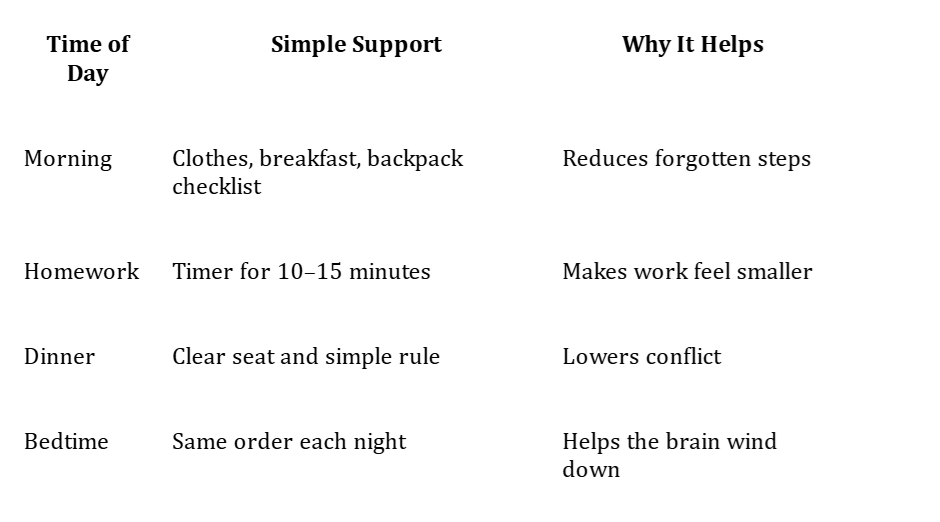
Also, catch your child doing something right. That sounds small, but it is powerful.
Say:
“You started fast. Nice work.”
“You came back when I called you.”
“You fixed that mistake.”
“You waited. That was hard, and you did it.”
Kids with ADHD often receive more correction than praise. Over time, that can hurt their self-esteem. Encouragement does not mean ignoring problems. It means your child still sees a path forward.
And parents need support too. Talk with your child’s doctor. Ask the school for help. Join a parent group. Read trusted sources. Small steps count.
Conclusion: Helping Your Child Move Forward
ADHD in children can feel confusing at first. One day, your child seems focused and joyful. The next day, a simple task turns into a storm. That up-and-down pattern can leave parents wondering what they are missing.
But once you understand the signs, the picture gets clearer.
Look for patterns. Notice where your child struggles. Listen to teachers. Watch how your child feels after hard moments. Then seek professional help when the signs affect daily life.
Most of all, remember this: your child is not the problem. Your child is a person who may need better tools.
With care, structure, school support, and the right clinical guidance, children with ADHD can grow, learn, connect, and thrive. The path may not be perfectly straight.
But it can move forward.
Disclosure: This is a collaborative post.